Bala Town and Villages
The name 'Y Bala' probably signifies an outlet, a name given due to the fact that the town is situated where the River Dee flows out of the lake. Bala lies along the course of the main road from Shrewsbury to Dolgellau and the town is situated at the northern end of Bala Lake (Llyn Tegid), where the rivers Dee and Tryweryn meet. It represents the finest example of a planned English borough in Meirionnydd and the circumstances of its creation are recited in the foundation charter.
This information is provided by Gwynedd Archaeological Trust.
The Roman road from Chester to Caer Gai and Brithdir must have passed through the area of modern Bala, and presumably close to Llanfor. It is thought then to run along the north-western shore of Llyn Tegid.
The presence of a Norman motte at Bala is a fairly certain indication of the existence of a Welsh lordship, perhaps the maerdref of Uwch Tryweryn in the cantref of Penllyn. The timber buildings of a royal llys and possibly the nucleated structures of a dependent bond township might be expected in the immediate vicinity of the motte. Once again the identification and elucidation of the character of a Welsh administrative focus and its relationship to a Norman earthwork castle and (in this case 14th century) planted borough become the key archaeological questions.
Tomen y Bala appears briefly in Welsh history; it was held by Elise ap Madog, Lord of Penllyn, who refused to back Llywelyn ab Iorwerth in his struggle against his kinsman Gwenwynwyn. His reward for this disloyalty was that in 1202 Llywelyn drove him from the site and destroyed the castle. It does not appear to have been re-fortified. When Roger Mortimer laid out the borough it was undoubtedly his intention to defend it with a wall and ditch incorporating this existing fortification. Indeed, the 1324 charter makes special provision for such work, but there is nothing to suggest that his instructions were ever carried out. An earthen bank may have been thrown up at the top of the town, however, parallel to the Afon Tryweryn, but the area has recently been developed and no sections are visible.
A further earthwork, Castell Gronw on the Dee at the point where it leaves the lake, must have been erected for the purpose of controlling the lake and commanding the crossing of the Dee, which was probably effected a short distance above the site of the castle. The mound is about 108 ft in circumference, 15 ft high from ground level, and 6 ft above the bailey; its summit is flat, and its slopes are covered with trees. The bailey lies to the southwest and was protected on two sides by a small stream. There is no historical information about the castle, but it may have been founded by the Goronwy family of Whittington in Shropshire.
During the later years of Edward II's reign the surrounding commote of Penllyn was in a state of disorder and virtually in the hands of marauding bands of thieves and robbers.
In or about 1310, therefore, Roger Mortimer set about the foundation of the town in an attempt to bring stability to the area and so that the town could serve as an administrative centre for the district. The borough was accordingly laid out with 53 burgage (house and garden) plots, each 200 ft by 26 ft (= 3,200 sq ft each), and within a year all but nine had been taken up by new citizens or burgesses.The medieval town was small and its total area did not exceed one square mile. Burgage plots were laid out along one principal street, with two back lanes running parallel to it, now represented by Arenig and Plassey/Mount Streets. Subsequent development, however, has destroyed most of the original plots.
The markets and fairs previously held at nearby Llanfor were transferred to the new settlement, which received its formal grant of privileges in 1324.
Penrhyn MS 408 in the Library of University College, Bangor, is a deed of sale, executed at Bala, by which, in consideration of 'a sum of money' and subject to the usual conditions and guarantees, one William de Preston, baker, of that town, sells in perpetuity to John de la Hyde, 'forester of North Wales' all his half-burgage in Bala with its buildings and appurtenances. This half-burgage lay between the burgage of Thomas de Piuelesdon and the half-burgage of 'Johannes fil Jonckyn'; it fronted the High Street (via capitalis) and ran back 'ad viam que ducit ad capellam' ('to the road leading to the chapel'). The witnesses named are: David 'Camerarius'; Roger de Badeley; Robert le Tipper; Griffin ab Akyn; Robert Barnesmill. The date is 'the Friday next before the feast of St. Michael-on-the-Mount, in the eighth year of Edward son of King Edward the Third after the Conquest', i.e. Oct 15, 1350. Contemporary references to some of the persons named can be found. Howel Goch, mentioned in the document as 'mayor', represented the 'burgenses anglici' of Bala at the quo warranto proceedings of 1348 (Record of Caernarfon pp 176, 210); John de la Hyde appears therein (ibid. p 152) as attorney general of one Thomas Cary, and a Thomas de Piuelesdon figures in the Extent of 1353 in Anglesey (Record of Caernarfon pp 106 and 226). This document is interesting for various reasons, not least that it reveals that although the borough charter (1324) was granted exclusively to 'burgenses anglici', there were by 1350 Welshmen in the borough, and that a Welshman was then mayor and representative of the burgesses.
From the outset Bala was a small settlement, with the burgesses dependent solely on agriculture or trade, and within the two centuries following its foundation many of the original burgages fell into decay. John Leland (1532-4) described Bala as 'a little poor market' and a decade later only 13 taxpayers were recorded in the town, a situation confirmed by Camden, who added that it was 'peopled with few inhabitants'.
A feature of the medieval town was the small chapel which stood near the town cross in High Street. There was no church at Bala until the building of Christ Church in 1811, the town being part of Llanycil parish, but the provision of the chapel appears to have been contemporary with the foundation of the borough. It continued to serve the community until the early 18th century, when it was finally demolished and its site, together with that of the attached graveyard, was built over.
The later history of Bala is uneventful and in the absence of any maintained castle the town does not figure large in the Glyndŵr revolt, although a small garrison place consisting of six timber houses was temporarily established.During the 18th century, the beginnings of a hosiery industry appeared in the town, which came to assume important proportions and led to much rebuilding. By the time of the 1842 tithe map the medieval area was again built up, and more recent development has enabled Bala to recapture its position as the market centre of Penllyn. The present day built-up area extends beyond the medieval borough to the north and west.
The 1946 RAF vertical aerial photographs show that the extent of Bala at that time was largely restricted to the medieval town, with no spread to the south-west.
Key historic landscape characteristics
Eighteenth- and nineteenth-century architecture, nucleated settlement, medieval street pattern
Key historic landscape characteristicsEighteenth- and nineteenth-century architecture, nucleated settlement, medieval street patternBlack’s Picturesque Guide to North Wales (1865) describes Bala as ‘a clean and neat town’. The town’s layout today certainly adheres to the standard form of a planned township and could therefore be described as neat.
The linear street plan of the historic town centre conforms to the archetype of the medieval market town, although the motte itself has also significantly influenced its character. The massive earthwork predates the medieval layout and consequently interrupts the standard format of parallel streets with neatly arranged burgages. The Borough charter of Bala allowed it to be a defended settlement but no walls or defences were ever constructed to compliment the existing motte. This is partly because in the period after c.1100 the advantages of market-street frontages were superseding defensive considerations (Aston & Bond, 2000).
The entirety of the modern town lies to the west of the river and it has never extended past Pont Tryweryn. The wide High Street, designed to facilitate market-trading, runs through the centre of the town to the bridge that gives the only access to the east and the main route towards Shrewsbury. This sort of restricted access is a distinctive feature of the medieval market town and could be used as a means of regulating traders and taxation (Aston & Bond, ibid).
Although the medieval burgage plots are no longer distinct entities the plot widths can still be seen in the street-front architecture and many of the plot boundaries still run from the High Street through to their respective back lanes and have not been subdivided or amalgamated. This is particularly evident in the row of terraces to the south of the High Street around Berwyn Street and up to the Mount.
Whilst the medieval settlement plan is still evident and gives the historic core its structure, much of the town’s built environment is post-medieval in date. The character of the urban building stock encompasses a mixture of architectural styles and materials along with buildings of varying scale and size that reflect the different functions, traditions and styles of the locality. With some 60+ listed buildings in the town and few undeveloped open spaces, the built environment forms an important part of the character of the area.
Local stone, generally dressed in large blocks, is the dominant building material across much of the town, but the High Street frontages are also formed from rough-cut natural stone, white-washed stone, facades and cladding, coloured render, and red and yellow bricks, both glazed and unglazed. Although the majority of these buildings are terraced, or at least linked, most are of individual design and the roof heights vary from low two-storey cottages to tall three-storey town house designs. This mixture of styles and materials is partly attributed to the excellent communication and distribution networks in Bala. In particular the railway must have facilitated trade and enabled the exchange of materials and ideas across a broad geographical area. However, the urban architecture also reflects the intellectual and cultural freedoms that many of the residents of Bala enjoyed throughout the 18th and 19th centuries and the enabling wealth that led to much of the necessary investment in the town.
Many of the more significant buildings in the town centre are public buildings, the most numerous building types being chapels and inns, with few private dwellings fronting the High Street. RCAHMW records 11 religious buildings in the town, and these can in large part be attributed to the town’s close historical links with Methodism (see above), while the many fine examples of the traditional inn show the significant role Bala played as an important stop-off on this historic route during the 18th and 19th centuries: for example, the White Lion Royal Hotel dates to c.1700 and retains its eighteenth century stable block.
One of the most significant public buildings in the town is the former workhouse. Unlike other examples at Conwy, Bangor and Caernarfon, the workhouse at Bala is located in the town centre, set back from the main road. It served as a home for relatively few of the 1030 paupers within the five parishes of Penllyn because of its unpopular location, and by 1869 it was being used as a militia barracks while a new workhouse was sited outside the town off Mount Lane. The original workhouse is today known as the Aran (Pyjama) Factory and continues the textile traditions of the town by manufacturing clothing.
The character of the back streets of Bala, in contrast with the very public space along the High Street boulevard, is formed in part by the low buildings and narrow lanes which make up the more private areas of the town. Small, stone-built terraced cottages with slate roofs are the most common form of dwelling while some large-scale stone buildings with bay windows survive on Tegid Street. Some of the more obvious planned terraced housing is as architecturally distinct as the more public buildings of the High Street, with numbers 48-52 Mount Street retaining good vernacular gothic character. The terraces, on the whole, were not constructed as planned developments, with the result that odd designs, shapes and sizes exist within the same adjoined row. Large windows are a recurring design in many of the cottages and are a reflection of the highly successful textile trade in the town. Much of the knitting and hand weaving was undertaken as a cottage industry in the home and good light would have been essential. Some of the outbuildings that back onto Mount Street from the High Street have the hallmarks of being light industrial units also built for this purpose.
Llanfor
The village of Llanfor is thought to date to the medieval period and it held local markets and fairs up until the 14th century when such events were relocated to Bala. There was a massive early Roman fort of mostly wooden structures at Llanfor which was detected from aerial photographs and geophysical surveys. There are also some Bronze Age burial sites nearby and something which might be a Medieval enclosure. The Rhiwlas Estate House is situated near Llanfor.

See more information from the Gwynedd Archaeological Trust
Llandderfel
Llandderfel is situated on the northern banks of the river Dee. The beautiful Pale Hall, a Victorian Country Manner set in 16 acres of gardens, can be viewed from the road and is famous as it was once visited by Queen Victoria in 1889. Crogen Hall dating back to 1380 is also at Llandderfel. In the 1920s a private unmanned railway halt was built especially for the residents. St. Derfel’s Church was dedicated to Derfel Gadarn, Derfel the Strong a loyal and gifted knight. The church has a magnificent oak screen carved in about 1500.

Llanuwchllyn
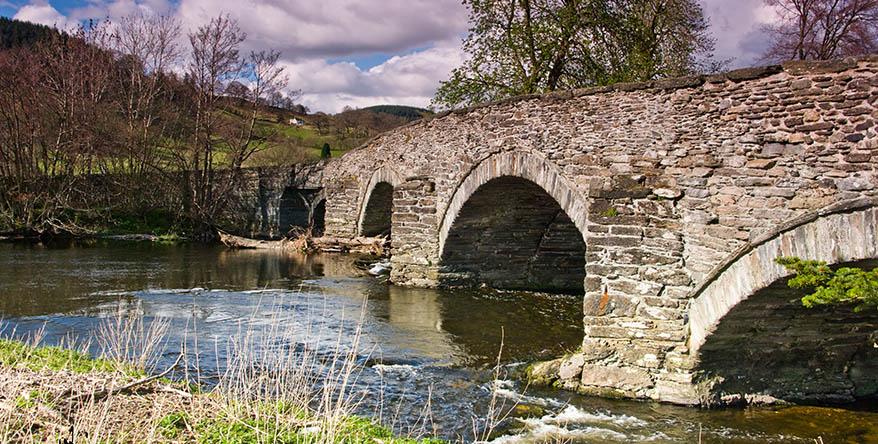
Llanuwchllyn is on the southern edge of Bala Lake (Llyn Tegid) and has a backdrop of the Aran Mountains which rise steeply to almost 3,000ft. The village has a beautiful bridge spanning the river Twrch and was one of the first villages in Wales to harness the power of the water to create electricity for the village. Nearby is the site of the Roman fort of Caer Gai, occupied from 75-150 AD. Llanuwchllyn Church has a very old foundation that was rebuilt in 1872. It contained a 14th Century recumbent. The church is now closed. Sir Ifan ap Owen Edwards, who in 1922 founded the Welsh Youth Movement, Urdd Gobaith Cymru, was born in Llanuwchllyn. The village is home to the Bala Lake Railway and there are regular journeys throughout the day to the town of Bala.

See more information from the Gwynedd Archaeological Trust
Bala Lake Railway - Gwynedd Archaeological Trust
Llangower
Llangower is a small hamlet set on the banks of Llyn Tegid. Llangower Church is set in an idyllic location its construction is very simple and it is dedicated to St. Cywair. There are many tombs reminiscent of prehistoric burial chambers overshadowed by a remarkable yew tree. There is a picnic area and narrow guage railway halt for the Lake Railway.

See more information from the Gwynedd Archaeological Trust
Llanycil
Llanycil covers the area north of the lake and includes the Bala Golf Club. The Ordnance Survey 2nd edition map (1888) shows this area to be predominantly rock and scrub with scattered patches of woodland. In contrast, the surrounding landscape at this time existed much as it does today, made up of neatly arranged agricultural holdings, enclosed fields and farmsteads. The church of Llanycil overlooks Llyn Tegid, Bala Lake and is built on an anciant Celtic Christian site. Mary Jones at just 15 walked from Llanfihangel y Pennant to buy a bible from Rev. Thomas Charles who was waiting to meet her at Llanycil Church. Thomas Charles was laid to rest in this churchyard.

More information: Historical Landscape of Bala & Penllyn
Thanks to the Gwynedd Archaeological Trust for permission to use this information.